




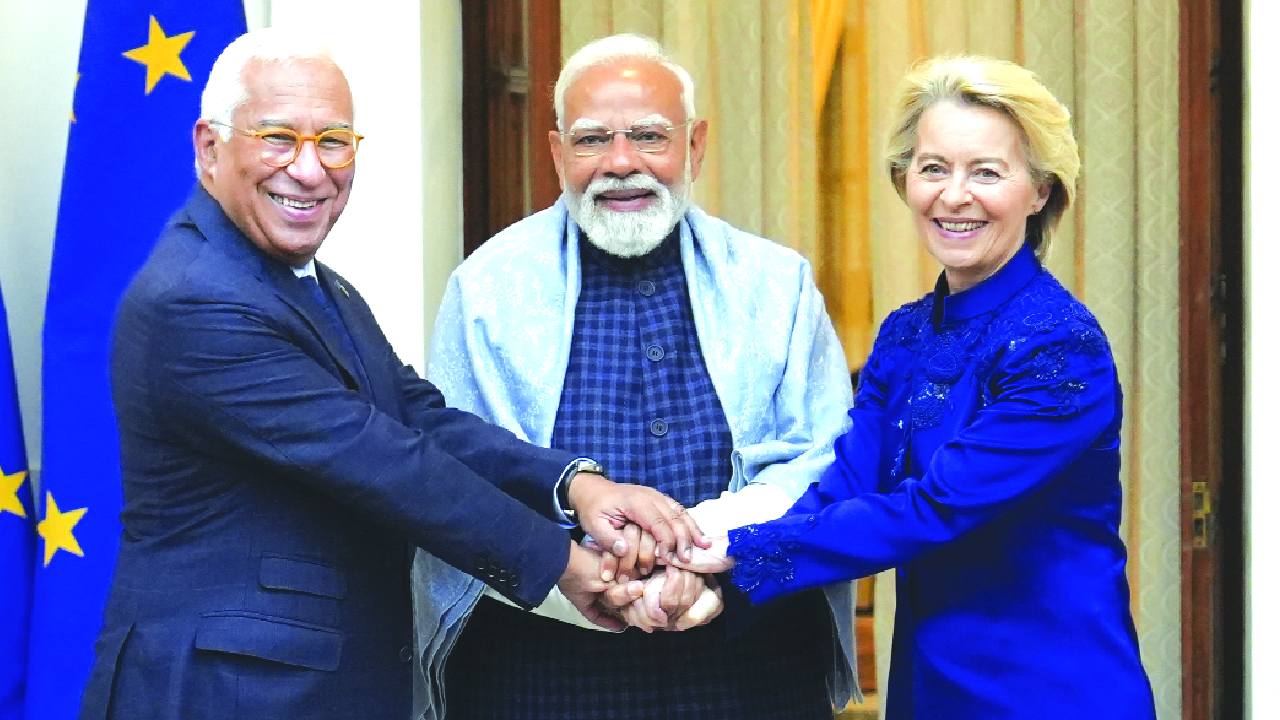
India and the European Union have officially wrapped up negotiations for a long-awaited Free Trade Agreement (FTA), marking a decisive upgrade in one of India’s most strategic economic relationships. Framed as a modern, rules-based pact, the agreement is designed to meet today’s supply-chain anxieties, geopolitical jitters, and the not-so-small ambition of deeper market integration between the world’s fourth- and second-largest economies.
A Deal Measured in Trillions
The numbers tell a loud story. With a combined market size of nearly INR 2,091.6 lakh crore (USD 24 trillion) and a consumer base of roughly 2 billion people, the FTA opens doors at a scale rarely seen. Over 99% of India’s exports (by value) will enjoy preferential access to the EU without India surrendering policy space in sensitive sectors. Trade diplomacy, but with guardrails.
Bilateral trade momentum was already healthy:
- Merchandise trade touched INR 11.5 lakh crore (USD 136.5 billion) in FY 2024–25
- India’s exports to the EU: INR 6.4 lakh crore (USD 75.8 billion)
- Services trade: INR 7.2 lakh crore (USD 83.1 billion)
Yet, for markets of this size, most observers agree we were still cruising well below cruising altitude. The FTA aims to change that.
Leather & Footwear: Zero Duty, Maximum Impact
One of the biggest winners?
India’s leather and footwear sector, long admired for craftsmanship, often punished by tariffs.
Thanks to the FTA, EU import duties ranging from 2.5% to 17% will drop to zero from day one. This levels the playing field for Indian exports currently valued at INR 20.9 thousand crore (USD 2.4 billion) and positions them to claw a larger share of Europe’s INR 8.71 lakh crore (USD 100 billion) leather and footwear import market.
For MSMEs, this isn’t just tariff relief it’s a runway. Regulatory alignment, simpler compliance, and a push toward sustainable, design-led products could finally move Indian exporters from low-margin manufacturing to higher-value brand leadership.
“Non-leather footwear which previously faced even steeper duties will also see tariffs eliminated to zero significantly improving competitiveness in the EU market.” Amit Chopra, MD Shoes & Accessories
What India Gets: Fast, Deep and Broad Access
India secures preferential access across 97% of EU tariff lines, covering 99.5% of trade value:
- 70.4% of tariff lines (90.7% of exports): Immediate zero duty
Textiles, leather, footwear, tea, coffee, spices, sports goods, toys, gems & jewellery, select marine products - 20.3% of tariff lines (2.9% of exports): Zero duty in 3–5 years
Processed foods, certain marine products, arms & ammunition - 6.1% of tariff lines (6% of exports): Tariff reductions or TRQs
Poultry, preserved vegetables, bakery products, autos, steel
Labour-intensive sectors together accounting for over INR 2.87 lakh crore (USD 33 billion) in exports stand to gain immediate competitiveness, deeper EU value-chain integration, and, crucially, jobs.
What Europe Gets: Access, But on India’s Terms
India’s offer to the EU is generous but calibrated:
- 92.1% of tariff lines (97.5% of EU exports) covered
- 49.6%: Immediate duty elimination
- 39.5%: Phased elimination over 5, 7, or 10 years
Europe gets access, but not an overnight import invasion. Indian industry gets time to adjust.
High-tech EU imports are expected to lower input costs, diversify supply chains and help Indian firms plug more efficiently into global manufacturing networks.
Strategic Hedge as the US Door Narrows
Indian exporters, especially in leather and footwear, have been hit hard in the US by tariff shocks reportedly touching 50%, losing ground to Vietnam, Cambodia, Indonesia, and the Philippines. Discounts of 10–40% have become survival tactics. Against that backdrop, Europe suddenly looks less like an option and more like a necessity particularly as trade tensions linger under the shadow of Donald Trump–era tariff policies.
Key Takeaways
- Deal likely signed this year; implementation around 2027
Patience required this is trade, not fast fashion. - 99%+ of Indian exports get preferential EU access
- India cuts duties on just 30% of EU goods at launch
- 93% of EU goods go duty-free but over 10 years
- Big winners (for now): Indian exporters
- Still waiting: Indian retailers and consumers don’t expect duty-free European shoes and apparel to flood shelves just yet.