







A landmark meeting at the Ministry of Textiles marks a forward-looking moment for one of India’s most vital sectors
By SHOES & ACCESSORIES Editorial Desk
April 8, 2026: India’s non-leather footwear industry is entering an exciting phase of transformation, with a strong push towards a textile-led future. In a recent meeting with the Textile Minister, CIFI presented a forward-looking vision of how technical textiles can reshape the sector. A comprehensive proposal outlined key opportunities, current challenges and clear policy recommendations to strengthen the integration of technical textiles into footwear manufacturing. With the right policy support and leadership, the industry believes this shift can unlock innovation, enhance value addition, reduce import dependence and generate large-scale employment across the country.
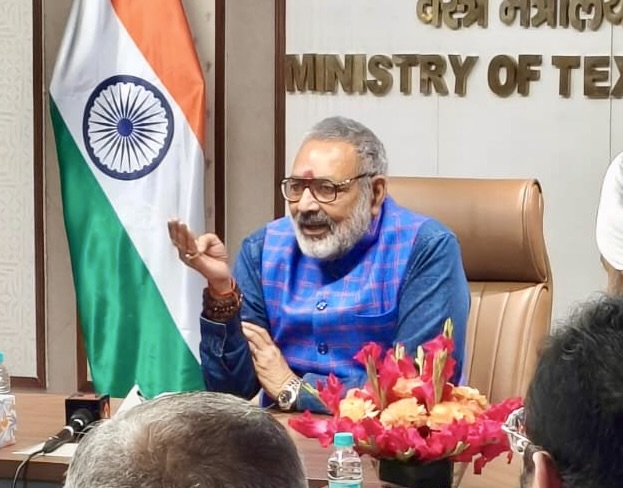
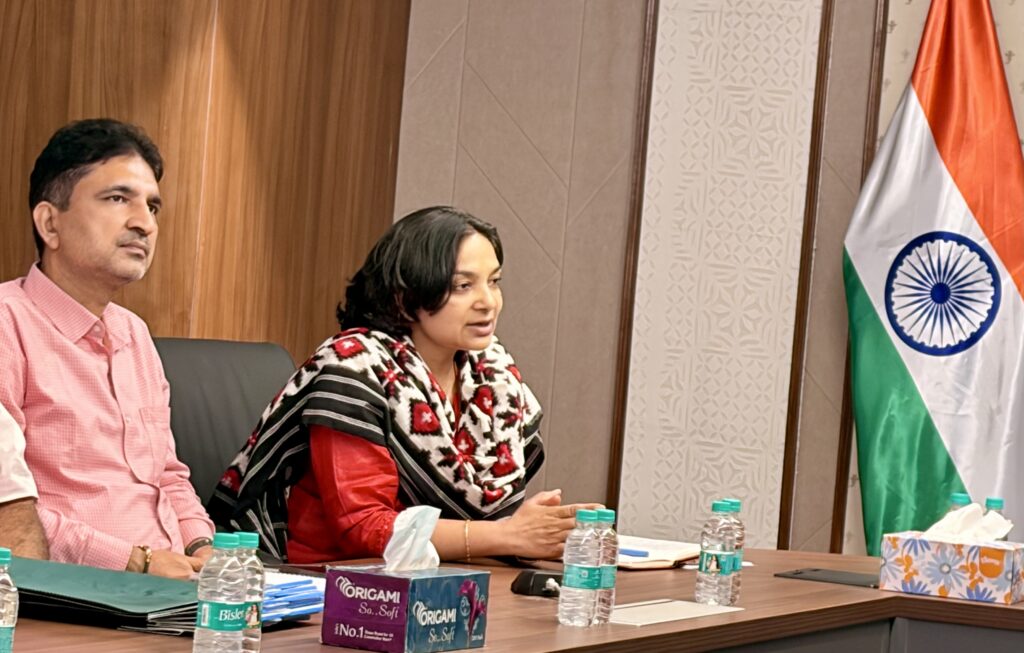
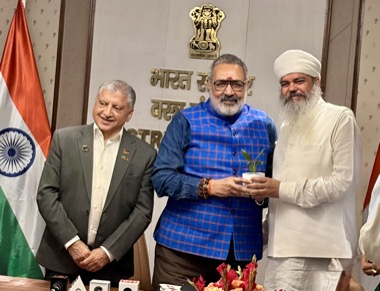
A high-level meeting at the Ministry of Textiles marked a significant and timely moment for one of India’s most promising manufacturing sectors. Shri Giriraj Singh, Hon’ble Union Minister of Textiles, engaged with the non-leather footwear industry and the Confederation of Indian Footwear Industries (CIFI) on April 7, 2026, at the Ministry’s new office in GPOA-3, Netaji Nagar. The meeting brought together leading manufacturers and material suppliers for an open and constructive dialogue on opportunities, challenges, and the road ahead.
Senior officials including Ms. Manisha Chatterjee, Joint Secretary, and Shri Ashok Malhotra, Director – National Technical Textiles, added both policy strength and technical depth to the discussions. The Minister’s intent was clear he was there to listen, understand industry realities, and explore how the Textile Ministry can actively support its growth. He encouraged stakeholders to share their challenges openly, while Ms. Chatterjee highlighted existing schemes, opening up a practical conversation on how current policy frameworks can be better utilised.
The meeting gained momentum through the sustained efforts of Dharmendra Narula, CIFI UP Chapter Chairman and MD, Guru Kirpa Enterprises, who has consistently driven dialogue with the government and championed the sector’s progress.

Setting a clear and focused tone from the industry side, Manuj Seth of Versatile Enterprises addressed a key structural issue. “The textile ecosystem must evolve to break monopolistic pricing structures in key inputs,” he said. “Non-leather footwear sits squarely within the textile value chain and distortions affecting textile raw materials are, by extension, distortions affecting footwear competitiveness. Bringing this sector formally under the Textile Ministry is not about optics. It is about accessing the institutional mechanisms to address these structural problems.”
Rajkumar Gupta, Past Immediate President CIFI and MD, Action Group brought the cluster reality into sharp focus. “The entire ecosystem in places like Bahadurgarh has evolved around non-leather footwear,” he said. “The scale is there. The industry is there. But the policy support hasn’t kept pace.” Bahadurgarh India’s largest non-leather footwear hub is perhaps the clearest illustration of a sector that has outgrown its policy framework. The Minister acknowledged the scale and importance of the footwear industry, highlighting its strong domestic base and its critical role in employment generation. He also expressed his willingness to visit the Footwear Park at Bahadurgarh to gain a deeper, on-ground understanding of the sector.
Dharmendra Narula, Managing Director of Guru Kirpa Enterprises and founder of the Medifeet brand, has been a strong voice behind this shift. His factory in Agra stands as a working example of this evolution. “We are no longer making footwear the traditional way,” Narula said. “We are engineering it through materials.” At the meeting, he further emphasised the importance of the supply side: “We need to rationalise raw material costs and ensure predictable pricing. Without that, global competitiveness will remain a challenge not just for individual companies, but for the entire sector.”
The industry’s potential is backed by strong numbers. India produces nearly 2.4 billion pairs of shoes annually, making it the world’s second-largest producer. However, in a global footwear export market of $170 billion, India’s share remains at just 2.2%. With 86% of global footwear consumption being non-leather—and India already producing around 80% in this category—the alignment is clear, and the opportunity is significant.
“India doesn’t have a demand problem, it has a value capture problem,” said Mayank Garg, Colence International. “The Indian footwear market could reach $90 billion by 2030. Non-leather will account for nearly 85% of that. If we align policy now, the export growth potential is transformational.”
Raw Materials: The Structural Fault Line
Non-leather footwear depends entirely on technical textiles and specialty chemicals high-performance yarns for knit uppers, TPU films and overlays, EVA and PU foam compounds, specialty adhesives, technical nonwovens. In many of these categories, 100% of inputs are imported. Where domestic production exists, the base chemicals themselves arrive from overseas. The result is a manufacturing sector that is deeply dependent on global supply chains for its inputs, yet struggles to participate in those same supply chains on the output side.
Alok Jain, Treasurer, CIFI & Managing Partner, Swastik Polymers shared his views to its fullest institutional framing. “This is not just an industry request,” he said. “It is a strategic imperative for India’s manufacturing future. Bringing non-leather footwear under the Textile Ministry’s framework is about creating the infrastructure – material, institutional, and financial that allows India to compete at the top of the global value chain.”
The Export Imperative
India has built strong manufacturing capabilities, with robust infrastructure, skilled workforce, and growing ambition. With the right policy alignment, the country is well-positioned to significantly expand its presence in global footwear exports. “Exports can grow exponentially if we align policy with how the industry actually operates today,” said Amit Chopra, Shoes & Accessories. “If we don’t build the domestic material ecosystem quickly, global brands will find better-supported assembly economies.”
A Ministry in Motion and a Window of Opportunity
The timing of this dialogue is particularly encouraging. The government’s expansion of the ₹10,683 crore Production Linked Incentive (PLI) scheme to include man-made fibres and technical textiles creates a strong opportunity for deeper integration with the footwear sector.
The minister acknowledged the sector’s challenges on raw materials and quality openly and assured stakeholders that efforts would be made to make the industry more vibrant.
The discussion brought together a strong cross-section of industry leadership, including Dharmendra Narula- CIFI UP Chapter Chairman and MD Guru Kirpa Enterprises, Rajkumar Gupta of Action Shoes, a driving force in India’s footwear industry, Manuj Seth- Versatile Enterprises, Govindaraju- Bata India Limited, Mayank Garg – Colence International, Alok Jain- Swastik Polymers, Sandeep Behl – Jasmine Knitting, Puneet Jain- Elasto Textiles Pvt Ltd, R. K. Khurana – Khurana India, Amit Chopra, Shoes & Accessories alongside other delegates representing footwear manufacturers, fabric producers and technical textile suppliers collectively reflecting the breadth and urgency of the industry’s agenda.