



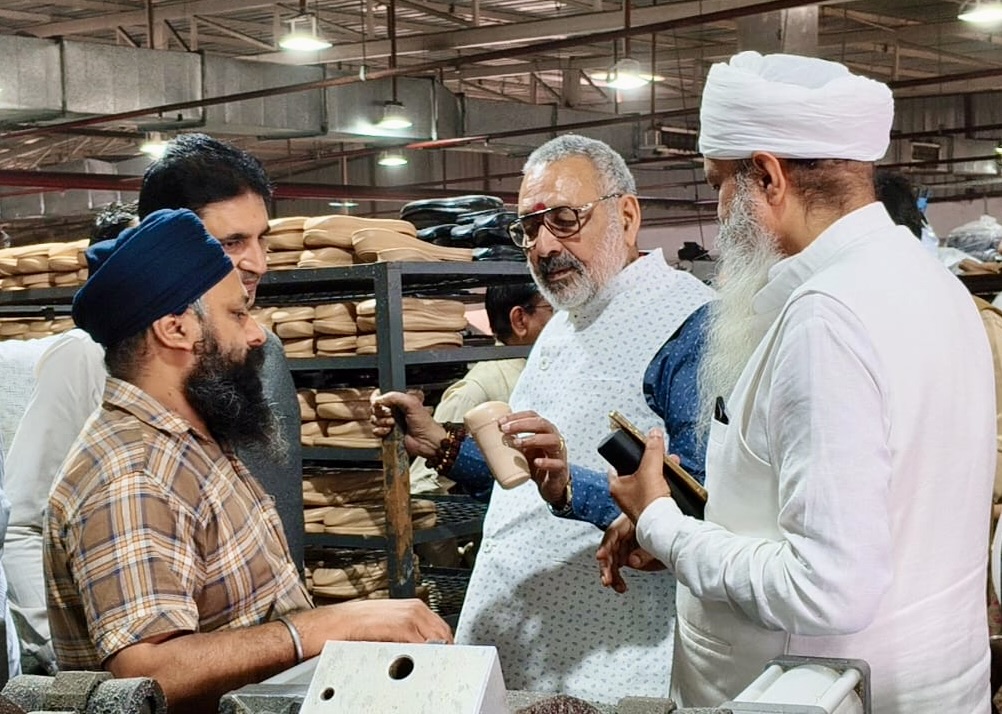



In a significant development underscoring the rising strategic importance of India’s non-leather footwear industry, Dharmendra Narula of Guru Kripa Enterprises (MEDIFEET) hosted Hon’ble Union Textile Minister Giriraj Singh along with Hon’ble Minister of State S. P. Singh Baghel on March 20, 2026, at his manufacturing facility in Agra. The visit evolved into a high-level discussion on the future trajectory of one of India’s fastest-growing manufacturing segments.
The interaction spotlighted the sector’s rapid transformation, increasingly driven by technical textiles and advanced materials. Impressed by the scale and innovation on display, the dignitaries engaged in detailed discussions on how engineered fabrics, synthetics, and new-age components are redefining footwear manufacturing positioning the industry as a key contributor to both domestic growth and export expansion.

In what could signal a policy shift with far-reaching implications, the non-leather footwear segment now accounting for over 90% of global footwear consumption is actively seeking formal recognition under the Ministry of Textiles, drawing parallels with China’s integrated policy framework.
A Factory Visit, A Policy Signal
During the visit, the ministers were given a comprehensive walkthrough of modern manufacturing processes, where technical textiles ranging from flyknits and engineered fabrics to resins and synthetic compounds form the backbone of production.

Officials acknowledged a clear structural shift: footwear today is no longer leather-centric but increasingly rooted in material science and textile innovation. Sources indicated that the Textile Minister expressed openness to exploring the inclusion of non-leather footwear components within the Ministry’s ambit, aligning policy with industry realities.
“We are sitting on a massive opportunity. The world has already shifted to non-leather footwear and India has the scale but without the right policy alignment, we risk falling behind. Integrating this sector with textiles is not optional anymore, it’s essential.” Dharmendra Narula
China’s Playbook, India’s Opportunity
The conversation repeatedly referenced China’s approach, where footwear components such as synthetic uppers, knit materials, and performance resins are classified under textile policy enabling integrated supply chains, targeted incentives, and strong export competitiveness.
China continues to dominate global production with over 54% share, though this has declined from 64.6% a decade ago creating space for emerging players. India, currently the second-largest producer at 12.5%, remains largely domestic-focused, contributing just 1.3% to global export value, highlighting a significant untapped opportunity.
On the demand side, China leads with nearly 4 billion pairs annually (18.6%), followed by India at 13.3%, reflecting strong demographic and consumption trends. The United States, while third in volume, stands out for its high per capita consumption, accounting for nearly 10% of global demand.
Industry Push: ‘Textiles is the Missing Link’
Dharmendra Narula emphasized the need for structural alignment with global competitors, noting that if raw materials and manufacturing are textile-driven, policy must follow suit.

Industry stakeholders argue that bringing non-leather footwear under the textile umbrella could:
- Unlock incentives similar to apparel
- Accelerate exports
- Strengthen domestic component ecosystems
- Reduce dependency on Chinese imports
The visit concluded on a positive note, with both dignitaries acknowledging the sector’s “vast potential and bright future.”